Coding Games and Programming Challenges to Code Better
Send your feedback or ask for help here!
Created by @Westicles,validated by @UnicornP,@FredericLocquet and @Ayza.
If you have any issues, feel free to ping them.
Coding Games and Programming Challenges to Code Better
Send your feedback or ask for help here!
Created by @Westicles,validated by @UnicornP,@FredericLocquet and @Ayza.
If you have any issues, feel free to ping them.
I don’t mean to be rude, but the “wrapping around” term can be unclear, is this possible to explain what it means (> and v go back to 0 at the end of the line, < and ^ go to max if they are on 0…) ?
Maybe I’mp the only concerned, but it did block me a bit.
Isn’t that the definition of wrapping around (for me at least it is)?
I’m just wondering, what did you understand by that?
Maybe it is in fact confusing and I just got lucky and assumed correctly.
Well, i didnt understand it at all, now i know what it means, at least
If this is a question, the answer is first solution each time. “Wrapping around” means that. Same issue than me
I wrote my solution and passed Test 1, Test 2 and Test 3.
Unfortunately Test 4, Test 5 and Test 5 fail because I end up in an endless loop because:
Obviously I made some mistake but because Test 4, 5 and 6 have so many arrows at the start it’s hard to find out where I went wrong. Does anyone have a hint or custom test case to help me find my error?
Luckily I found my error in my solution, it wasn’t an edge case but at some point I removed an arrow before checking if there maybe were others as well on the same position.
BTW, this may help others having doubts about a case like this:
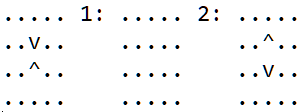
Based on results from the tests I think result should be 2 and arrows are allowed to pass each other as long as they don’t end up on the exact same position.
It is so funny to read a such complaint(when the statement of this puzzle is crystal clear) from the one who created Coding Games and Programming Challenges to Code Better puzzle which has tag a Reading the statement and 3 stars rating.
Making a comment 2 years after, and to say this ! 
I’m guessing you didn’t solve it. Too bad. Don’t hesitate to ask your questions in the dedicated forum 
My only question is why didn’t you follow point 2 of this guide?
P.S. I don’t need anyone’s help to solve puzzles.
Missing tags for
Loops
Hash
[Edit: Original poster has deleted their message.]
That’s not an appropriate comment. Would you please stop making similar comments in the future?
[Edit: Original poster has deleted their message.]
I’m a moderator. Your recent comment has violated the community guidelines. If this behaviour continues, you will be muted for at least one week, possibly longer. This is an official warning. Please reconsider how you engage with others on the forum.
It seems to me that some solutions should not pass, as they mark the cells where a ‘collision’ occured with an ‘x’, ignoring such marked cells for further tests. If you have two pair of arrows annihilating each other at the same location, those solutions will not pass (and they should) ??
Is it tested somewhere ?
Example:
 0123456789
0..........
1.>..>.....
2.....^....
3..........
4..........
5.....^....
6..........
There will be two different ‘annihilations’ @cell(5,1), one at t+1, one at t+4 ??
Am I wrong ?
You aren’t wrong.
I’m not sure what solutions you referred to. I’ve just tested 10 of the published Python solutions and all of them passed your custom case correctly.
I’m coding in C++ so … so checked some C++ solutions…
Hi, I have a code passing the 3 first tests and 2 first validators, but fails with timeout on harder tests, due to some leftover arrows in parallel lines/columns.
Can anyone think of a simple example with edge cases, or any other method to investigate further without manually reviewing the tests case with loads of arrows ?
Try running your code locally to check if it produces the correct output without the time limit. This can help you determine whether your code is stuck in an infinite loop or if it’s too slow.
Seems to be an infinite loop rather than a mere timeout.
I found a situation where it happens, but I’m unsure about what the exercise requires here.
2 1
v
^
It loops forever for me, as I move both arrows (in this example, it means they are swapped) before checking for any collision.
After each time step, if two or more arrows are in the same position they are all destroyed
The subject says this, so I understood “move first, check later”, but perhaps I misunderstood and my example should end in 1 step.
